
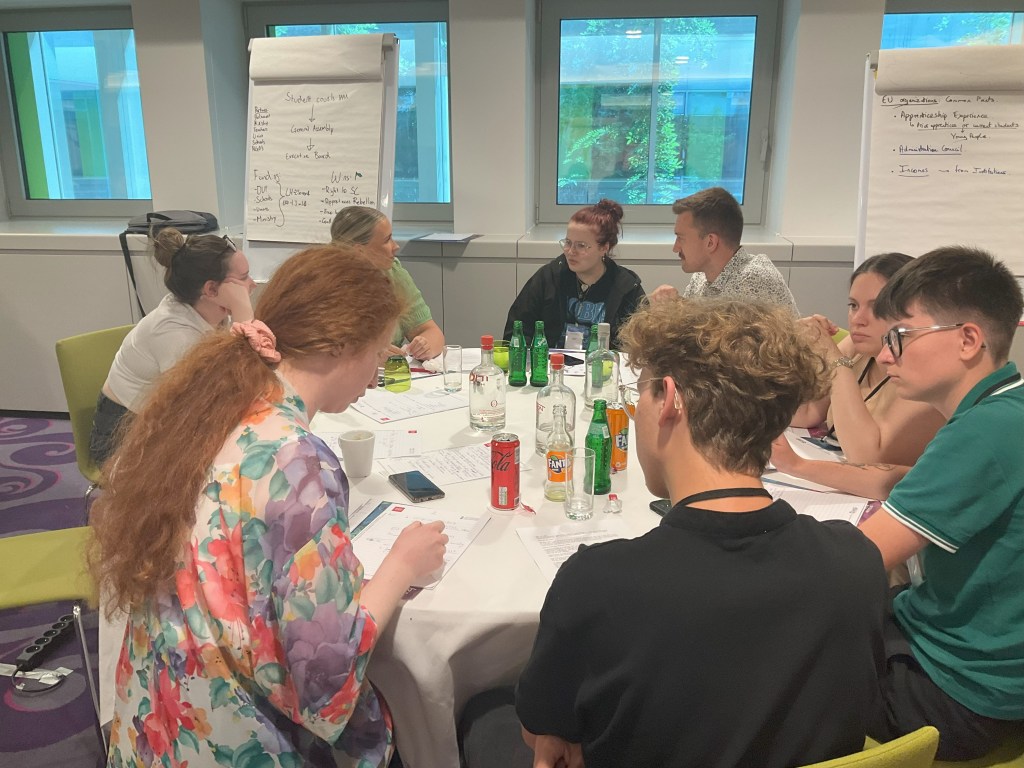
During the last week of June apprentices from all over Europe met in Brussels to partake in the EAN event. The event took place in concurrence with EAfA’s High-Level Events on Mental Health in Apprenticeships. The theme served as a great boost for the conversation around mental health care and access to quality support.
While mental health was the focus of the EAfA event, during the EAN meeting apprentices and panelists touched upon other areas that directly and indirectly affect apprenticeship, apprentices and their well being. These factors range from having access to health insurance, benefits, vacation time and sick leave and the lack of legislation safeguarding the social security of apprentices.
The workshops allowed participants to better grasp how different apprenticeship systems work, leaving some somewhat grateful for their own and others in disbelief of how few resources they had access to. These same topics were at the center of the conversation in Barcelona during “The voice of apprentices” in 2022.
Adequate mental health support goes beyond temporary and reactionary measures. It is imperative to put resources to work and lay the groundwork. The most pressing actions needed are:
- Funding of democratic representational bodies
- Support the nascence of new representational
- Funding the hiring and training of staff
That looks like prevention, fostering community and democratic representation. It entails flexibility of learning and pacing, in the ways in which a person can find their own footing back into their social, study and work life after a difficult period. For someone to get back on their track, there needs to be security in housing, access to care and compassion. The question is whether the VET world, still mainly oriented to the needs of the labor market and companies , is willing to nurture those who chose to pursue an apprenticeship. Not just for efficiency, but to create a positive learning environment that can then flourish in a nurturing work environment.
It is the way in which allows people to live through them or with them that sets the standard and practices. Can VET providers recognise that mental health needs attention beyond the framework of maintaining productivity? If not, what tools do they need to do so?
One thing is clear, there is no fix it all solution. Apprenticeships commit years to learning, developing expertise, know-how, giving new life to trades that struggled with generational change or with a mismatch in demand. Despite their contribution to society and the labor market, apprentices have to constantly advocate for themselves. For access to adequate resources during their apprentices and for recognition after. Moreover, outside of the VET world, apprentices face the stigma of not being in general and/or higher education, issues with validating their skills outside of their country/region. Be it the stigma, ignorance or whatnot, being an apprentice carries the burden of being a class indicator.
The event left all eager to work more and more to tackle all areas, from fair pay to tokenism, from Madrid to Tbilisi in the EAN. May the good work and momentum keep going after the end of the European Year of Skills.
Apprenticeships must go on.
Article written by EAN Secretariat.
 European Apprentices Network